Showing posts with label federal library. Show all posts

Sunday, November 18, 2012

EPA Region 10 Library

This week's post is provided by the University of Washington chapter of the Special Libraries Association. Ann Pool, SLA-UW Distance Representative, wrote the text, and co-Vice Chair Violet Fox provided pictures.
------------------------------------------------
The second SLA library crawl of the quarter took us to downtown Seattle. Our first stop was the EPA Region 10 Library on the 10th floor of the Park Place Building, overlooking Freeway Park. We first checked in at the Public Environmental Resource Center (PERC) where a wide variety of non-technical environmental publications are available free to the public. Liz Doyle, the librarian, met us there and gave us a tour of the library.
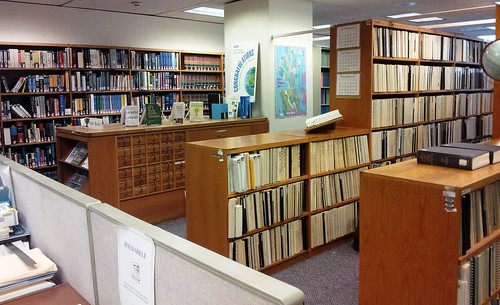
EPA Region 10 Library
The library has been open since the EPA was established in the early 1970s. Liz works with two assistants: Adam specializes in interlibrary loans, and Kara deals with serials and reference. The main patron base consists of about 600 EPA staff members in Washington, Oregon, Idaho, and Alaska, including those in remote locations. It’s also open to the public. Liz tries to encourage people to come in to the library. Although electronic access has become the most frequent mode of library use, some people do like to come to the library for a quiet work environment.

The library’s technical systems may not be state of the art, but they serve their purposes well. Items are bar coded and checked out with cards issued to each patron. The library uses Inmagic’s DB/TextWorks catalog as well as an agency-wide union catalog. They also have a regional intranet with a library portal listing free and fee-based information. Patrons appreciate the simple interface.
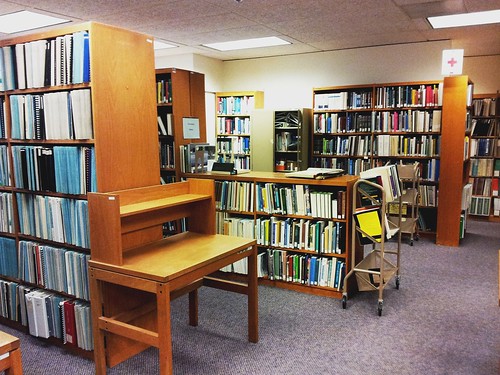
EPA Region 10 Library
They’ll be moving down to the first floor soon, which will locate them next to the PERC and make them more visible to the public. As often happens with moves, many print documents will be weeded. Liz looks at demand patterns and the possibility of printing on demand when making weeding decisions.

While ready reference questions have declined substantially as people can look up simple questions on line, the library does get a good number of reference requests through their Ask a Librarian online form. Liz told us about a recent question where a staffer needed a new handbook on output-based emissions and was unable to find it. She located it quickly for the patron. Liz also enjoys training people on research locally and through webinars. She often answers small questions but is better able to convey the big picture of the research process through training sessions.

Liz’s prior work experience helped her get hired for her current position. She had worked at law firms after graduating from library school at the University of Michigan, so when the EPA was looking for someone with experience in legal research and cataloging she had the right combination of skills. It pays to learn new things!

Sunday, November 11, 2012

National Library Service for the Blind and Physically Handicapped

Today we're talking about talking book and braille libraries; specifically the National Library Service for the Blind and Physically Handicapped (NLS) administered by the Library of Congress. This service was established in 1931 with an act of congress, commonly known as the Pratt-Smoot act. The text is found in Title 2, Chapter 5, section 135a of the US Code and establishes an annual appropriation in the budget to Library of Congress for the dissemination of books in accessible format.

Unfortunately at the time of writing this, the NLS website is down for maintenance during the entire veterans day weekend. The NLS itself is an office located just north of Columbia Heights in Washington, DC. Visionaware has a great brief description of the service, which I'm copying here because, admittedly, it's easier than paraphrasing.

"The National Library Service for the Blind and Physically Handicapped (NLS), Library of Congress, administers the Braille and Talking Book Library Service, a free program that loans recorded and braille books and magazines, music scores in braille and large print, and specially designed playback equipment to residents of the United States who are unable to read or use standard print materials because of visual or physical impairment.

Local cooperating libraries throughout the United States mail NLS audiobooks, magazines, audio equipment, braille books, and braille magazines directly to enrollees at no cost. Talking books and magazines and braille publications are delivered to eligible borrowers by postage-free mail and through a network of cooperative libraries. Religious publications include: Bibles, Other Scriptures, Liturgies, and Hymnals in Special Media.

From a beginning of 19 cooperating libraries, the network has expanded to 57 regional and 74 subregional libraries throughout the U.S."

Most state libraries administer braille and talking book libraries through State Libraries. You can find a list of libraries on the NLS website, or use this list from VisionAware. Check out the Washington Talking Book and Braille Library for an example of the services available at the state level.
The service provided by the NLS and the network of libraries is invaluable for connecting the visually impaired with accessible information, literature, and technology tools. I highly recommend visiting a library in your area to learn more about the amazing technology available, and the programs operating locally across the nation. If you're interested in this area of librarianship as a career path and in working in DC, NLS has a job opening for a Digital Reference Librarian. The post is open until December 6th. The application process is fairly rigorous and Library of Congress still requires full KSA essays. Good luck if you apply. And as my closing, here's an interesting example of the material transcribed into braille by the NLS.

Sunday, September 30, 2012

The Floral Library

If you've ever found yourself near the tidal basin in Washington, DC, just across the Kutz bridge and looked to your right at the intersection of Independence and Marine Ave, you may have seen some flower beds and wondered, what's up with those? The beds are the Floral Library, maintained by the National Parks Service National Mall & Memorial Parks department. Also known as the 'Tulip Library', the 93 beds were founded in 1969 as part of Lady Bird Johnson's Capital Beautification Project.

I had the wonderful opportunity to interview Alice McLarty, Landscape Architect, and Maureen Joseph, Regional Historic Landscape Architect, about the floral library. There are few links online that talk about the library's history or current care. This one mentions the tulip garden, however the article from the National Park Service is actually almost exclusively about tulips. Alice and Maureen were kind enough to fill me in on the details. I'd like to say that their jobs are fascinating. I'd talk more about them, but this post would go on forever. I'll just say I love being a librarian, but were I to go back in time and have a choice, I might choose historic landscape architect as a career.

When the library began to bloom in the spring of 1969, there were 95 varieties of tulips planted in groups of 100 to 200. Then Regional Director Nash Castro said in a press release from March 1969, "The concept of the library is to give interested persons an opportunity to study and compare the tulip varieties as well as view them at close range and at a leisurely pace." There were three seasonal plantings with Tulips in the spring, annuals in the summer, and chrysanthemums in the fall

The beds haven't changed much in the intervening 43 years. There are now 93 beds due to sidewalk widening a few years ago. There are two planting seasons, tulips and annuals, and the annuals tend to last into the fall. The ground maintenance staff maintains the beds and McLarty manages the ordering and evaluates how plants are doing. McLarty said of the selection, "The varieties generally are the same year after year, but with substitutions by the grower for various reasons, and changes by our staff if we see that a particular plant is not doing well. Or if conditions change, such as the elimination of shade loving annuals after the huge elm tree, which had shaded the west end for years, died. We have no shade loving annuals anymore, but someday we will again when the replacement elm gets larger."

The layout has remained essentially the same. This link takes you to the 2012 library map. You can see the shift from 95 to 93 beds, when compared to this library map for the chrysanthemums from 1971. This announcement shows the original designer, Darwina Neal, among the tulips.
These pictures were taken in July, when the annuals were in bloom. The official name of this library without books is the Floral Library, however many people still refer to the beds as the Tulip Library. It's not known why, as McLarty mentioned, even when it started it had three distinct planting seasons.

Sunday, September 9, 2012

Books that Shaped America

This week I'd like to bring the focus back to the Library of Congress to take a look at the Books that Shaped America exhibit on display now through September 29th. The exhibit is part of the multi-year Celebration of the Book. I visited a few weeks ago and very much enjoyed the experience. The exhibit is located in the Southwest Exhibition Hall in the Jefferson Building on Capitol Hill, just outside the Thomas Jefferson Library Exhibition.

The Jefferson Building is open on Saturdays and there was quite a crowd when I was there. It was nice to hear the common exclamation, "I love that book" and to overhear stories of how a particular title was personally influential, or brought up fond memories spent reading. I saw many books that have mattered to me over the years, and each selection was thought provoking in how its existence and influence helped shape America.

If you are able to visit before the end of the month, I highly recommend it. I also want to plug the National Book Festival, taking place on the National Mall September 22-23. I am glad to be able to check it out this year. If it's a bit far for a visit, check out the list of books online to find your favorites. These are a few of mine.


Sunday, June 3, 2012

National Library of Education

The United States Department of Education was established in 1980 by combining several federal agencies to work towards the mission of promoting "student achievement and preparation for global competitiveness by fostering educational excellence and ensuring equal access." - Ed.gov. The department headquarters in Washington, DC is spread among several buildings. The library is located in the Lyndon Baines Johnson (LBJ) Department of Education Building on Maryland Ave.

LBJ Building

Although the library is in the basement of the building, the space has a picture window across from the reference desk that looks out onto a green space, which lets in natural light. The National Library of Education (NLE) collection contains over 60,000 books and more than 1000 English language electronic and print journals with a central focus on education, but also includes related subject areas such as "law, public policy, economics, urban affairs, sociology, history, philosophy, psychology, and information science" - NLE. The library is administered under the The National Center for Education Evaluation (NCEE), which is tasked with evaluating federal programs and disseminating information, among other things. The NCEE also oversees the Education Resources Information Center (ERIC) which is the world's largest digital library of grey literature on education such as conference, research, or policy reports and papers. ERIC was developed to provide an easy to use and search widely accessible database of bibliographic and full-text education research and information. While, commercial vendors may offer more extensive access to full text databases, ERIC is still a very useful resource for research into this subject area.

The NLE is open to the public for on-site access to collections, as well as services by phone, web, fax and mail. Services include statistical and reference services, government documents access as a Federal Depository Library and access to some material through inter-library loan. The library catalog is available online for search, although many of the electronic resource links are restricted and require on-site access or ILL request through your local public, school or academic library.

One question I came across through a visit to Library of Congress was posed by a researcher there. I attended a tour of the Business Resources Reading Room. We were discussing the collection development policy of the LOC and an attendee asked if any library keeps a historical archive of textbooks used in public schools, if someone were researching what was taught in the past and how it has changed. I thought it was an interesting question. Library of Congress doesn't generally collect textbooks, which is explained in the education section of the collection development policy. The librarian did say they sometimes receive reference questions from students looking for the teacher's guide with answers to tests.

In case you are now wondering, there doesn't appear to be a definitive collection of historical textbooks. I conducted a very quick and in no way exhaustive search for libraries with textbook collections. Library of Congress has a special collection of McGuffey Reader Collection. Indiana University of Pennsylvania has a collection development policy for textbooks, to support the College of Education and Educational Technology, but only keeps current editions. The University of Chicago Library has a subject guide pointing to a few more collections of historical textbooks. Other resources include The Center for Research Libraries, Nietz 19th Century Schoolbooks, or the Harvard Graduate School of Education special collection of historical textbooks.

You can add National Library of Education to the list. Their collection of textbooks is organized by subject and contains textbooks for the mid 1800s to the mid 20th century. The library’s collection also includes most of the reports by the Department and its predecessors going back to the 1870’s as well as a collection of federal education legislation. This library is yet another example of fascinating special collections where the ability to focus collection to a specific subject area allows the collection to dig deep for information available with a narrow scope. If you have the opportunity to visit, check out the school bus collection at the entrance. It's pretty adorable.
reference desk

stacks
journals and reference
Legal Reference
Past Directorsschool buses
school buses

Sunday, May 27, 2012

US Census Library

I recently had the opportunity to visit the United States Census Library in Suitland, MD. The library moved into the renovated building in 2006. It is a very bright and airy space, and features an impressive piece of art by Sam Gilliam.

The Census library does not have a public web presence due to security restrictions, although, the library space and collections are open to the public for research. Contact library@census.gov for more information.

The collections are best described by a portion of the mission of the Census Bureau Library, which "is to furnish relevant and timely information services and collections needed for informed decision-making by Census Bureau and government employees on-site and electronically, as well as to the public via electronic reference and inter-library loan services. The Census Bureau Library is the leading source for information resources produced by the Census Bureau and information about those resources."

The core of the collection are Census publications. Population Census records are stored and accessed at the National Archives. The Census Bureau gathers all kinds of information, beyond the familiar decennial population census. There are US Export records, a collection of articles and papers written by Census Bureau employees which began in the 90's, Business Statistics, Agricultural reports, etc. These publications are collected and preserved by Census library staff. The library collection also contains some rare historical statistic information, such as reports from the first Census in 1790.

The Census Bureau has discontinued the Statistical Abstracts of the United States, however ProQuest announced in March they will be picking up where the Census Bureau leaves off. The Census Library also recently took charge of an extensive collection of international statistical information. The collection developed through a reciprocal exchange program other countries. The library staff are hard at work processing and cataloging the vast collection. While the Census library does not have a public web presence or public web access to their catalog, their records are uploaded to World Cat and they do share some resources through Inter-Library Loan.

Census building entrance
Building entrance atrium with view of Suitland Mansion through the Window
The Reference Desk
The General Collection Stacks
US Export Statistics
The Author Papers
The VaultHumidity Check

The library is a wonderful resource for research into historical statistical information. The future direction of the library is a focus on electronic acquisitions and reference services, as well as continuing to maintain the collection of Census publications. Interns and volunteers are accepted, although due to the level of security at the Bureau of the Census, security background checks are required. Students in an ALA accredited program are preferred. And of course, no library can be complete without the Nancy Pearl Librarian Action Figure.

Librarian Action Figure

Sunday, May 20, 2012

NOAA Western Regional Center Libraries

The Student Chapter of the Special Library Association at University of Washington (SLA-UW) hosts 'library crawls' each quarter for students of the Information School. The crawl takes students to two or three special libraries or collections in the Seattle area to introduce them to the variety of opportunities available. Students meet with librarians at the site, tour the collections and discover special libraries. The most recent library crawl hosted by SLA-UW visited the National Oceanic and Atmospheric Administration Western Regional Center. Two SLA-UW officers submitted pictures and notes from the tour for this week's post. A special thank to Ann Pool for the text, and Violet Fox for the photos. You can access the Flickr stream for additional images from their crawl.
____________________________________

SLA-UW’s latest library crawl on May 9th took us to two of the three National Oceanic and Atmospheric Administration (NOAA) libraries in Seattle: the NOAA Seattle Regional Libraryand the National Marine Mammal Laboratory (NMML) Library, both located in Sand Point.(The third is the Northwest and Alaska Fisheries Science Centers Library in Montlake.) Sixteen students attended this tour led by Brian Voss, the NOAA library director and a UW MLIS graduate.

Brian’s undergraduate background is in zoology and conservation ecology. He then went into NOAA’s fisheries observer program for a couple of winters before ending up in library school. During that time he worked in the Natural Sciences Library and for the Gates Foundation. He did a directed field work (DFW) at the Marine Mammal library and then went right to NOAA after receiving his MLIS. Brian was most interested in the tech classes, and said that the best ones taught concepts that are used regardless of changes in technology.

The three libraries serve the Western region offices. The NOAA library focuses on physical oceanography and atmospheric science. The primary use of the NOAA library is journal subscriptions to support research. Some nautical charts have been digitized but there are usability issues with viewing them online. The library also supports some email reference with the public and non-NOAA-affiliated social scientists. NOAA is now partnering with the National Technical Information Service (NTIS) on a pilot program to create a digital repository; this was prompted by documents from the Deepwater Horizon oil spill.

Sonja Kromann, another UW MLIS grad, directs the NMML library. Its walls are lined with file cabinets containing articles reprinted from print journals the library didn’t subscribe to. Articles are no longer added to the files as periodicals are now available online, but the existing articles are still only indexed in the card catalog. The library also contains a collection of theses and archives, including the Fur Seal Archive which was Brian’s DFW project.

If solo librarianship or scientific libraries sounds interesting, you might want to consider a DFW at NOAA. Brian has worked with many DFW students in the past and has a couple of project ideas, including cataloging and inventorying the regional libraries’ online subscriptions, depending on your interests. After the tour we walked down to the Sound Garden sculpture located on NOAA's grounds and then enjoyed happy hour at the Monkey Pub. NOAA library nautical charts
NOAA library nautical charts
NOAA library reading room
NMML library
Sound Garden

Sunday, May 6, 2012

Office of the Comptroller of the Currency Library

The Office of the Comptroller of the Currency (OCC) was established in 1863 and tasked with the mission "to charter, regulate, and supervise all national banks and federal savings associations." (OCC Website). The OCC is an independent bureau under the Department of the Treasury and does not receive appropriation funding from Congress. The bureau is sustained through assessment fees paid by banks and federal savings associations as well as investment income. See the OCC website for access to publications from the bureau. For further information on the history of the bureau, see this OCC publication.

Many federal agencies have strict network security measures that preclude libraries from providing public access to catalogs, web resources, etc. The library of the OCC does not have a web presence, and portions of the collection are not open to the public for security reasons. The space is open to research visits upon request. The library is a selective depository with the Federal Depository Library Program, and as such, must make those portions of the collection accessible to the public. Click here for OCC library contact information. The OCC collection focuses finance, banking, and has several stacks of statutes and regulations at the state and federal level. A unique part of the collection are the bound legislative histories created by librarians on staff.


The library is located on the 9th floor of the OCC offices. The view from the windows is impressive. The OCC is moving offices in a few weeks and the view will be significantly different, but library staff and extensive collections will continue to serve OCC patrons from their new home. Here are some shots of the current view, and a model of the Treasury building in downtown DC (A gift to the Treasury Department that founds its way to the OCC library.