Showing posts with label law. Show all posts

Sunday, November 18, 2012

EPA Region 10 Library

This week's post is provided by the University of Washington chapter of the Special Libraries Association. Ann Pool, SLA-UW Distance Representative, wrote the text, and co-Vice Chair Violet Fox provided pictures.
------------------------------------------------
The second SLA library crawl of the quarter took us to downtown Seattle. Our first stop was the EPA Region 10 Library on the 10th floor of the Park Place Building, overlooking Freeway Park. We first checked in at the Public Environmental Resource Center (PERC) where a wide variety of non-technical environmental publications are available free to the public. Liz Doyle, the librarian, met us there and gave us a tour of the library.
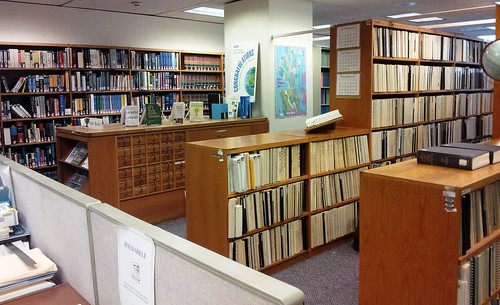
EPA Region 10 Library
The library has been open since the EPA was established in the early 1970s. Liz works with two assistants: Adam specializes in interlibrary loans, and Kara deals with serials and reference. The main patron base consists of about 600 EPA staff members in Washington, Oregon, Idaho, and Alaska, including those in remote locations. It’s also open to the public. Liz tries to encourage people to come in to the library. Although electronic access has become the most frequent mode of library use, some people do like to come to the library for a quiet work environment.

The library’s technical systems may not be state of the art, but they serve their purposes well. Items are bar coded and checked out with cards issued to each patron. The library uses Inmagic’s DB/TextWorks catalog as well as an agency-wide union catalog. They also have a regional intranet with a library portal listing free and fee-based information. Patrons appreciate the simple interface.
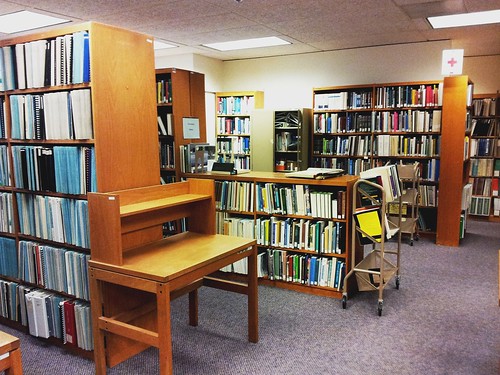
EPA Region 10 Library
They’ll be moving down to the first floor soon, which will locate them next to the PERC and make them more visible to the public. As often happens with moves, many print documents will be weeded. Liz looks at demand patterns and the possibility of printing on demand when making weeding decisions.

While ready reference questions have declined substantially as people can look up simple questions on line, the library does get a good number of reference requests through their Ask a Librarian online form. Liz told us about a recent question where a staffer needed a new handbook on output-based emissions and was unable to find it. She located it quickly for the patron. Liz also enjoys training people on research locally and through webinars. She often answers small questions but is better able to convey the big picture of the research process through training sessions.

Liz’s prior work experience helped her get hired for her current position. She had worked at law firms after graduating from library school at the University of Michigan, so when the EPA was looking for someone with experience in legal research and cataloging she had the right combination of skills. It pays to learn new things!

Sunday, September 16, 2012

Public Law Library of King County

Law Libraries come in many forms. Law schools are required to have law libraries, which tend to be administratively separate from university library systems. Most academic law libraries tend to be closed to the public, unless they are depositories within the federal depository library program, or the campus is more open to the public. It varies, as to the level of public access for these libraries as their primary purpose is to serve the school to which they are attached. Most law firms, court houses, counties, and cities have law libraries. Many special or public libraries contain legal collections although law might not be the primary collection focus.

The King County Law Library in Washington State is a public law library that provides access to legal resources for free to anyone who visits the two locations; the King County Courthouse in downtown Seattle or the Maleng Regional Justice Center in Kent, WA. The law library provides check-out privileges to Subscribers. Other services include Conference Room Space, computer use, and access to legal and research databases. The library offers classes on legal topics for a range of experience levels.

The mission of the Public Law Library of King County is to provide the public with access to legal resources. "Without access to information, there is no justice. Public Law Library of King County aids all persons with their need for legal information by providing legal materials, training, education, and services in a welcoming and positive environment." Law librarianship is a fascinating field that tends to draw on people with legal degrees. Most take specialized courses within an MLIS program, or a condensed program in addition to possessing a law degree. Not all law librarians have law degrees, but most have prior legal experience. Law librarians are not practicing layers and cannot give legal advice, but can direct patrons to resources or provide direction to where to find legal counsel.

I had the opportunity to visit the law library in the King County Courthouse with a group of MLIS students as part of a library crawl with the University of Washington chapter of the Special Library Association. In addition to the collections and helpful staff, they also have great views of some Seattle landmarks, such as the Smith Tower.


Sunday, June 3, 2012

National Library of Education

The United States Department of Education was established in 1980 by combining several federal agencies to work towards the mission of promoting "student achievement and preparation for global competitiveness by fostering educational excellence and ensuring equal access." - Ed.gov. The department headquarters in Washington, DC is spread among several buildings. The library is located in the Lyndon Baines Johnson (LBJ) Department of Education Building on Maryland Ave.

LBJ Building

Although the library is in the basement of the building, the space has a picture window across from the reference desk that looks out onto a green space, which lets in natural light. The National Library of Education (NLE) collection contains over 60,000 books and more than 1000 English language electronic and print journals with a central focus on education, but also includes related subject areas such as "law, public policy, economics, urban affairs, sociology, history, philosophy, psychology, and information science" - NLE. The library is administered under the The National Center for Education Evaluation (NCEE), which is tasked with evaluating federal programs and disseminating information, among other things. The NCEE also oversees the Education Resources Information Center (ERIC) which is the world's largest digital library of grey literature on education such as conference, research, or policy reports and papers. ERIC was developed to provide an easy to use and search widely accessible database of bibliographic and full-text education research and information. While, commercial vendors may offer more extensive access to full text databases, ERIC is still a very useful resource for research into this subject area.

The NLE is open to the public for on-site access to collections, as well as services by phone, web, fax and mail. Services include statistical and reference services, government documents access as a Federal Depository Library and access to some material through inter-library loan. The library catalog is available online for search, although many of the electronic resource links are restricted and require on-site access or ILL request through your local public, school or academic library.

One question I came across through a visit to Library of Congress was posed by a researcher there. I attended a tour of the Business Resources Reading Room. We were discussing the collection development policy of the LOC and an attendee asked if any library keeps a historical archive of textbooks used in public schools, if someone were researching what was taught in the past and how it has changed. I thought it was an interesting question. Library of Congress doesn't generally collect textbooks, which is explained in the education section of the collection development policy. The librarian did say they sometimes receive reference questions from students looking for the teacher's guide with answers to tests.

In case you are now wondering, there doesn't appear to be a definitive collection of historical textbooks. I conducted a very quick and in no way exhaustive search for libraries with textbook collections. Library of Congress has a special collection of McGuffey Reader Collection. Indiana University of Pennsylvania has a collection development policy for textbooks, to support the College of Education and Educational Technology, but only keeps current editions. The University of Chicago Library has a subject guide pointing to a few more collections of historical textbooks. Other resources include The Center for Research Libraries, Nietz 19th Century Schoolbooks, or the Harvard Graduate School of Education special collection of historical textbooks.

You can add National Library of Education to the list. Their collection of textbooks is organized by subject and contains textbooks for the mid 1800s to the mid 20th century. The library’s collection also includes most of the reports by the Department and its predecessors going back to the 1870’s as well as a collection of federal education legislation. This library is yet another example of fascinating special collections where the ability to focus collection to a specific subject area allows the collection to dig deep for information available with a narrow scope. If you have the opportunity to visit, check out the school bus collection at the entrance. It's pretty adorable.
reference desk

stacks
journals and reference
Legal Reference
Past Directorsschool buses
school buses

Sunday, May 6, 2012

Office of the Comptroller of the Currency Library

The Office of the Comptroller of the Currency (OCC) was established in 1863 and tasked with the mission "to charter, regulate, and supervise all national banks and federal savings associations." (OCC Website). The OCC is an independent bureau under the Department of the Treasury and does not receive appropriation funding from Congress. The bureau is sustained through assessment fees paid by banks and federal savings associations as well as investment income. See the OCC website for access to publications from the bureau. For further information on the history of the bureau, see this OCC publication.

Many federal agencies have strict network security measures that preclude libraries from providing public access to catalogs, web resources, etc. The library of the OCC does not have a web presence, and portions of the collection are not open to the public for security reasons. The space is open to research visits upon request. The library is a selective depository with the Federal Depository Library Program, and as such, must make those portions of the collection accessible to the public. Click here for OCC library contact information. The OCC collection focuses finance, banking, and has several stacks of statutes and regulations at the state and federal level. A unique part of the collection are the bound legislative histories created by librarians on staff.


The library is located on the 9th floor of the OCC offices. The view from the windows is impressive. The OCC is moving offices in a few weeks and the view will be significantly different, but library staff and extensive collections will continue to serve OCC patrons from their new home. Here are some shots of the current view, and a model of the Treasury building in downtown DC (A gift to the Treasury Department that founds its way to the OCC library.


Thursday, April 5, 2012

Library of the Department of the Interior

The Library of the Department of the Interior (DOI) was established in 1850 by Thomas Ewing, Jr., the son of the first Secretary of the Interior. The library today is housed in the Department of the Interior building on 18th and C street. The DOI consists of several bureaus: National Park Service, U.S. Fish and Wildlife, Bureau of Indian Affairs, Bureau of Land Management, Office of Surface Mining, Bureau of Ocean Energy Management, Bureau of Safety and Environmental Enforcement, U.S. Geological Survey, and the Bureau of Reclamation. As such, the library collection contains a wide variety of information to match the varied areas of interests of DOI affiliates. More information about DOI library collections can be found here. The library provides access to an extensive amount publicly accessible information on the web through it's Internet Guides. The Library website is definately worth checking out, as well as browsing through to other areas of the DOI website as a whole. The DOI itself has a presence on various social media networks, and provides a variety of multi-media resources such as Webcams, Videos, and Podcasts.

The library is also an architecturally fascinating space. You can read about the Art and Architecture on the website and the library is open to the public if you are located nearby and would like to stop and visit. The Park Ranger Speaker Series is a great way to learn more about aspects of sites of interest or history of Washington, DC.

You can also see the library in film, such as in the 1987 Kevin Costner thriller No Way Out. The library's spectacular stacks can be seen during a chase scene near the end of the movie. The Stacks consist of six decks on three floors, constructed by Navy contractors. The stairs between the decks are a steep an narrow climb, and navigating the space is an impressive, although slightly claustrophobic experience.

I recently took some pictures from one of the rare book section balconies. If you do happen to visit, be sure to ask the reference librarian about the clock.