Showing posts with label state library. Show all posts

Sunday, March 3, 2013

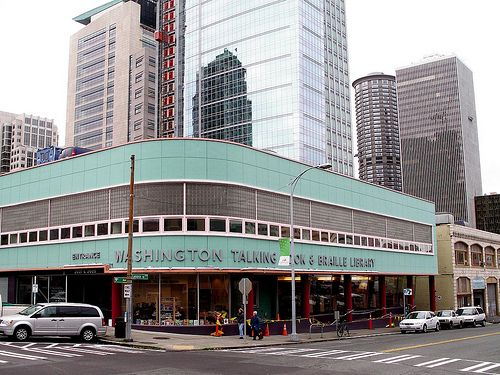
Fred Hutchinson Cancer Research Center Library and Washington Talking Book and Braille Library

The student chapter of the Special Libraries Association at the University of Washington (SLA-UW) shared their report of a library crawl in January. The group started at Fred Hutchinson Cancer Research Center’s Arnold Library and then continued on to the Washington Talking Book & Braille Library (WTBL). Thanks to SLA-UW officer Violet Fox for the pictures and distance representative Ann Pool for the great report about the experience.

---------------------------------------------------

SLA-UW kicked off winter quarter with a South Lake Union library crawl. We started at Fred Hutchinson Cancer Research Center’s Arnold Library.
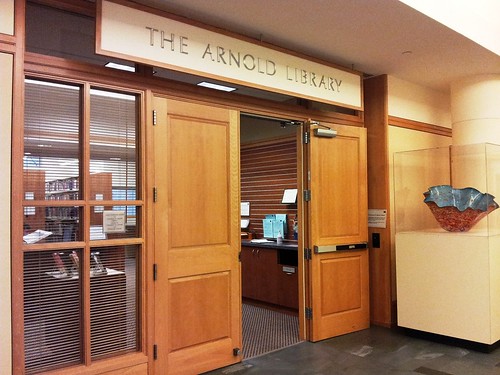
Fred Hutchinson library
Doug Shane, the acquisitions librarian, was our tour guide. Ann Marie Clark is the library’s director and spoke to us before the tour. The library is very supportive of the iSchool. Most of the librarians are UW graduates and they regularly offer internship and student work opportunities. Fred Hutch is very innovative and provides great support for the library so that the librarians can support the researchers effectively.

Arnold Library is similar in many ways to an academic library as the majority of their work involves supporting federally funded, grant based research. Fred Hutch used to include a hospital but no longer does. Instead they partner with the Seattle Cancer Care Alliance for patient treatment. The library does get some questions from patients, usually quite technical as they come from people who have already done a good amount of research.

Like other libraries we have visited, Arnold Library has seen changes and continues to adapt to researchers’ needs. They canceled all print journal subscriptions in 2008 and get them all online now. The library is embedded in the center’s shared resources group and contains the group’s computer center, partially located in the former reference room. Upstairs, a room that used to hold print journals is now being converted into video production use. Next to that room is a quiet study area.

The librarians do a lot of “house calls” to assist and train researchers. They train on citation management software and help researchers get their papers into PubMed Central. They handle many interlibrary loan requests and do outreach especially as major changes happen. Providing and communicating the library’s value is always important, just as it is for all libraries today.

Most of the staff came in with little or no medical or scientific background, but expertise in finding information and using reference tools. Many have worked their way up from office roles and built domain knowledge along the way. When asked what MLIS courses would have helped him in his career, Doug mentioned archives as particularly useful since they are getting into digitizing and organizing an archive. He also would have taken more technical classes.
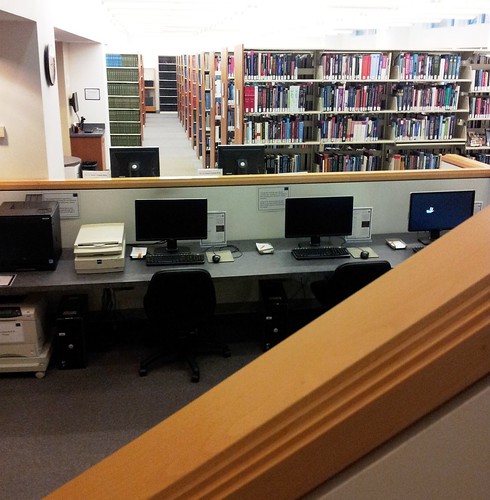
Fred Hutchinson library

We rode the streetcar to the Washington Talking Book & Braille Library and arrived as Mandy Gonnsen, the youth services librarian and iSchool class of 2012, was setting up a poetry slam for teens with an anti-Valentine’s theme.
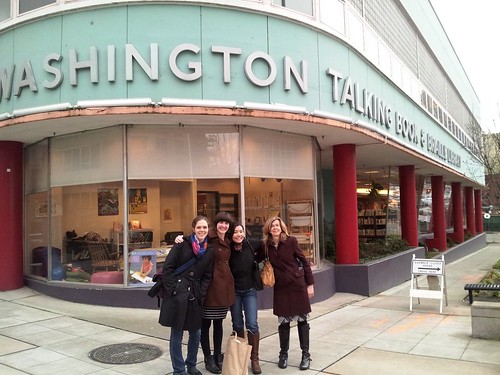
WTBBL
Her outreach activities focus on getting kids to come in and feel comfortable, and providing a community space. Mandy is taking a Braille class and demonstrated for us on a vintage-looking Brailler. She showed us some of the different ways books can be adapted for the visually impaired. They can add Braille to picture books, which generally already have large print. For blind parents to read to their sighted children they can also make transparent Braille overlays and bind them between book pages.

Mandy works with schools, generally via telephone and email, to get them the types of books they need for their visually impaired students. She does outreach both at the library and in schools. The summer reading program lasts eight weeks and the library mails out packets with book lists, vocabulary words, and activity and craft supplies.

After spending time with Mandy we toured the library with David Junius, the volunteer services and outreach coordinator.
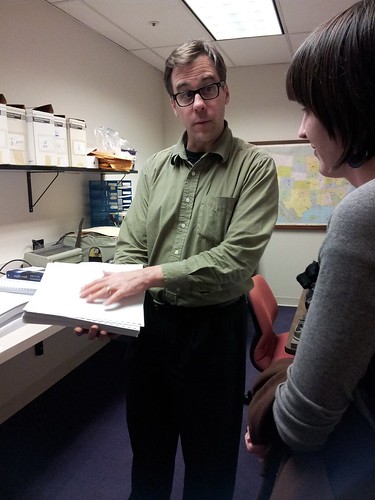
WTBBL braille books
WTBBL serves people who are visually impaired or unable to hold books. Services are free and supported by the Free Matter for the Blind program of the NLS. The library has a large print collection on site similar to what might be found at a public library, but is now focusing more on Braille and audio materials. Readers’ advisors work is done via phone and email, looking at what books people have read and taking their interests into account. Readers can get books automatically by mail with a service that resembles Netflix or on request.

The shipping area is filled with books in Braille and two audio formats. The majority of the audio collection is still on cassettes, but digital cartridges are gradually replacing them. Some Braille and audio books are produced locally, with a focus on Northwest authors and subjects.
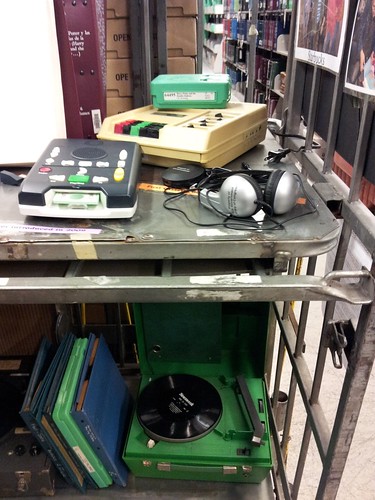
WTBBL talking book playback equipment
David keeps the Evergreen Radio Reading Service running and showed us the audio production equipment and software he uses. The library also has a computer lab with screen readers and Braille displays as well as an OCR scanner. The children’s room, visible through large picture windows, is open to the community.

Thank you to the folks at Fred Hutchinson's Arnold Library and the Washington Talking Book & Braille Library for sharing their knowledge and time!

Sunday, November 11, 2012

National Library Service for the Blind and Physically Handicapped

Today we're talking about talking book and braille libraries; specifically the National Library Service for the Blind and Physically Handicapped (NLS) administered by the Library of Congress. This service was established in 1931 with an act of congress, commonly known as the Pratt-Smoot act. The text is found in Title 2, Chapter 5, section 135a of the US Code and establishes an annual appropriation in the budget to Library of Congress for the dissemination of books in accessible format.

Unfortunately at the time of writing this, the NLS website is down for maintenance during the entire veterans day weekend. The NLS itself is an office located just north of Columbia Heights in Washington, DC. Visionaware has a great brief description of the service, which I'm copying here because, admittedly, it's easier than paraphrasing.

"The National Library Service for the Blind and Physically Handicapped (NLS), Library of Congress, administers the Braille and Talking Book Library Service, a free program that loans recorded and braille books and magazines, music scores in braille and large print, and specially designed playback equipment to residents of the United States who are unable to read or use standard print materials because of visual or physical impairment.

Local cooperating libraries throughout the United States mail NLS audiobooks, magazines, audio equipment, braille books, and braille magazines directly to enrollees at no cost. Talking books and magazines and braille publications are delivered to eligible borrowers by postage-free mail and through a network of cooperative libraries. Religious publications include: Bibles, Other Scriptures, Liturgies, and Hymnals in Special Media.

From a beginning of 19 cooperating libraries, the network has expanded to 57 regional and 74 subregional libraries throughout the U.S."

Most state libraries administer braille and talking book libraries through State Libraries. You can find a list of libraries on the NLS website, or use this list from VisionAware. Check out the Washington Talking Book and Braille Library for an example of the services available at the state level.
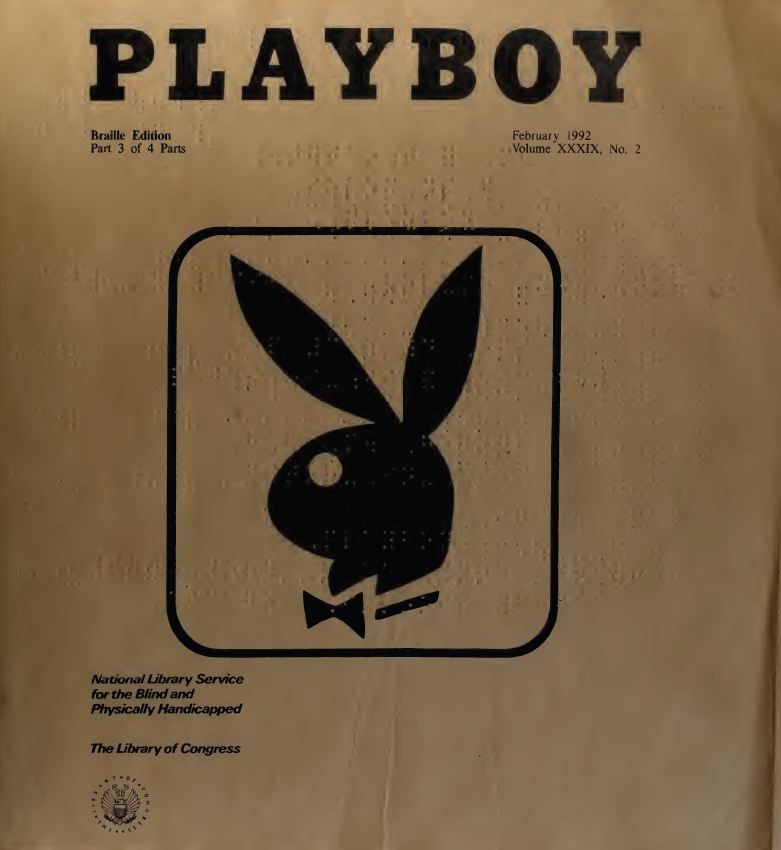
The service provided by the NLS and the network of libraries is invaluable for connecting the visually impaired with accessible information, literature, and technology tools. I highly recommend visiting a library in your area to learn more about the amazing technology available, and the programs operating locally across the nation. If you're interested in this area of librarianship as a career path and in working in DC, NLS has a job opening for a Digital Reference Librarian. The post is open until December 6th. The application process is fairly rigorous and Library of Congress still requires full KSA essays. Good luck if you apply. And as my closing, here's an interesting example of the material transcribed into braille by the NLS.

Sunday, June 24, 2012

The Hawaii State Library

The Federal Depository Library Program (FDLP) was established by Congress to ensure the American public has access to a certain level of government information. Since 1813, depository libraries have safeguarded the public's right to access by collecting, organizing, maintaining, preserving, and assisting users with information from the federal government. The FDLP provides government information at no cost to designated depository libraries throughout the country and territories. These depository libraries, in turn, provide local, no-fee access to government information in an impartial environment with professional assistance.

As institutions committed to equity of access and dedicated to free and unrestricted public use, the nation's nearly 1,250 depository libraries serve as one of the vital links between "We the people" and our Government. Anyone can visit federal depository libraries and use the federal depository collections which are filled with information on careers, business opportunities, consumer information, health and nutrition, legal and regulatory information, demographics, and numerous other subjects. - Taken from the FDLP Desktop Website

The FDLP newsletter often highlights Federal Depository Libraries (FDLs). This week's post is a re-post of the highlight of the Hawaii State Library. The images and text below were taken from the FDLP newsletter. Check out the list of other depository library highlights on the FDLP Desktop and to read the original post on the Hawaii State Library.

In the interest of not crossing the lines of fair use , I am only including a portion of the original post, and some of the photos, and encourage you to read the full post in the FDLP newsletter and check out some of the other libraries on the highlight list.
_______________________________________
Would you like to apply for a U.S. passport and learn about traveling abroad and the countries you’re visiting? Are you an inventor researching patents? Are you also interested in foreign trade and marketing possibilities for your product? In Honolulu, Hawaii, you’re in luck; the Hawaii State Library (HSL) has a rich Federal depository collection and offers many additional services involving U.S. Government information. In addition to serving as a Federal depository library since 1929, spanning years as a U.S. territory and state, the library’s Federal Documents Section partners with other Federal agency programs for services that regularly attract new visitors and returning patrons alike. The knowledgeable and helpful staff express, “E Komo Mai” or “Welcome” to all.

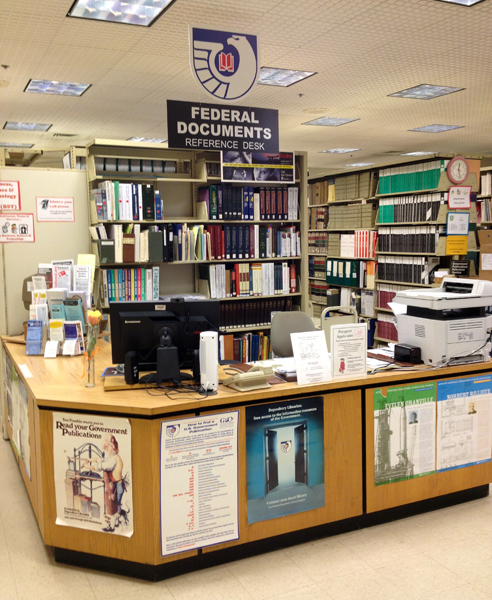
The Hawaii State Library is the main library of the Hawaii State Public Library System, which supports three Federal depositories within the state. When entering the library building, the Federal Documents Section is clearly identifiable with colorful Government posters. The unit has a historic Federal depository collection, public computers, staff-created resource guides, and much more. Federal Documents Section staff have proactively sought out opportunities that enhance access to the Federal depository collection and U.S. Government information in general, resulting in greater visibility for the depository collection and the library. Read the full article here.

Government Documents Reference Desk
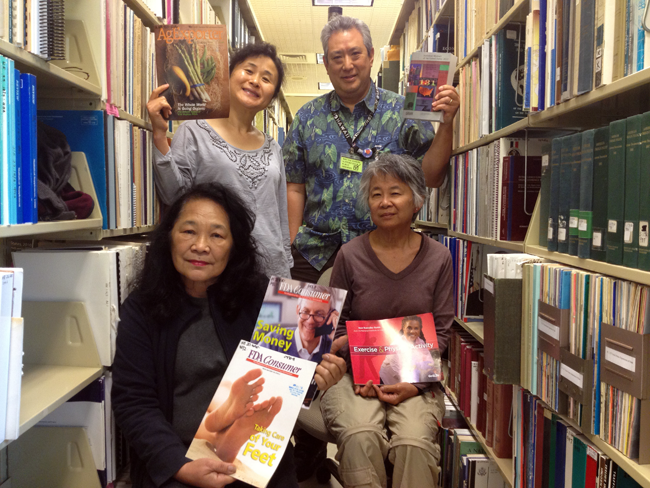
Government Documents Staff
Patent Searching